Create Your Own Story From a Simple Idea
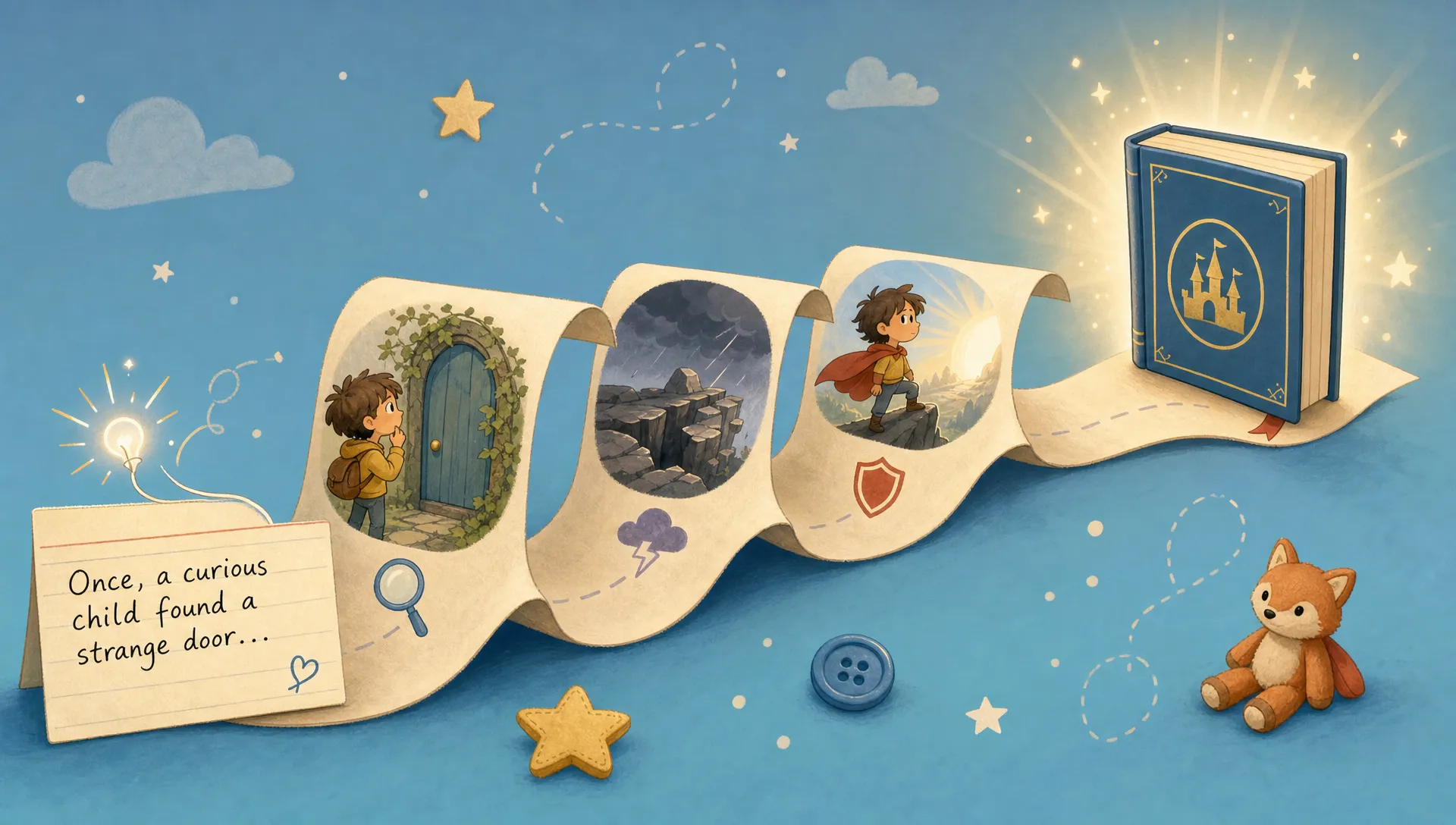
A simple idea is enough to start a story. It might be a sentence your child said at breakfast, a family memory, a favourite animal, a “what if?” question, or a character who will not leave your imagination alone.
The hard part is rarely finding an idea. The hard part is knowing what to do with it next.
If you want to create your own story, especially a personalised story for a child, you do not need to begin with a perfect plot. You need a small spark, a clear emotional direction, and a practical way to shape that spark into scenes. From there, you can build characters, add tension, choose a satisfying ending, and eventually turn the whole thing into a book, ebook, audiobook, or keepsake.
This guide will show you how to turn a simple idea into a story that feels complete, personal, and enjoyable to read aloud.
Start with a one-sentence story seed
Every story needs a seed. This is not a full plot summary. It is the smallest version of the story, usually built around one character, one want, and one problem.
A useful formula is:
Someone wants something, but something gets in the way, so they must do something brave, clever, kind, or surprising.
That sentence gives your story movement. Without it, an idea can stay flat, even if it sounds charming.
For example, “a child visits the moon” is an image. “A shy child wants to return the moon’s lost silver button, but the night sky keeps changing, so they must learn to follow their own little light” is a story seed.
| Simple idea | Stronger story seed |
|---|---|
| A dragon who likes baking | A young dragon wants to win the village bake-off, but every cake keeps catching fire, so he must find a new way to use his flame. |
| A child with a magic umbrella | A child wants to stop a rainy birthday picnic from being cancelled, but the umbrella keeps flying away, so she chases it into a cloud city. |
| A lost teddy bear | A teddy wants to get home before bedtime, but the house looks enormous from the floor, so he asks forgotten toys for help. |
| A cat in space | A curious cat wants to nap on the moon, but every planet is too noisy, so she searches the galaxy for the quietest corner. |
If your idea feels too small, add a want. If it feels too vague, add a problem. If it feels too random, add a reason the character must act now.
Choose who the story is really for
Before you write, decide who will read or hear the story. A bedtime story for a four-year-old needs a different rhythm from an adventure chapter book for an eight-year-old. A personalised birthday book has different emotional goals from a classroom story about courage or kindness.
Think about the reader’s age, interests, attention span, and favourite kinds of humour. Younger children often enjoy repetition, clear emotions, gentle surprises, and strong visual moments. Older children may enjoy mysteries, twists, jokes, world-building, and more complex choices.
This is also where personalisation can make a story feel magical. A child might recognise their pet, their favourite colour, their big sister, their home town, their football boots, or the way they always ask one more question before bed. These details tell the child, “This story was made for you.”
The key is to personalise with purpose. Do not overload the story with every detail you know. Choose a few that support the plot or deepen the emotional connection.
Give the main character a clear want
A memorable story usually begins with a character who wants something. It does not need to be grand. In children’s stories, small wants can carry big feelings.
A character might want to:
- Find a missing toy before bedtime
- Make a new friend at school
- Prove they are brave enough to try swimming
- Rescue a tiny creature in the garden
- Build the biggest pillow fort in the world
- Hear a bedtime story from a busy parent
Once you know what the character wants, ask why it matters. A child does not simply want to win a race. They may want to feel proud, be noticed, help a friend, or show themselves they can keep going.
That emotional reason is what gives the story heart.
Build the story around one main feeling
Stories are easier to shape when you know the feeling you want to leave behind. Do you want the reader to feel cosy, brave, amused, reassured, curious, or proud?
This matters because the same idea can become many different kinds of story.
A child who discovers a tiny door in the garden could become a funny story about talking worms, a gentle bedtime story about a secret fairy library, or a thrilling adventure about rescuing a trapped star. The idea is the same. The feeling changes everything.
If you are writing for a child, choose one emotional promise and keep it in mind as you make decisions. A cosy story should not suddenly become frightening. A silly story can have a tender moment, but it should still return to playfulness. A brave adventure can include worry, but it should guide the child towards confidence.
Use a simple story spine
You can create your own story without complex plotting. A simple story spine is often enough, especially for picture books, early readers, personalised books, and bedtime tales.
Think of the story in five parts:
| Story part | What it does | Question to answer |
|---|---|---|
| Beginning | Introduces the character and world | Who are we following, and what feels normal? |
| Wish or problem | Gives the story a reason to move | What does the character want, or what has gone wrong? |
| Attempts | Shows effort, mistakes, and discoveries | What do they try, and why does it not work at first? |
| Turning point | Helps the character understand something | What do they learn, choose, or notice? |
| Ending | Resolves the story with emotion | What changes, and how should the reader feel? |
This structure works because it gives the story a beginning, middle, and end without making it feel mechanical. You can use it for a five-minute bedtime tale or expand each part into a chapter.
For a longer story, each chapter can have its own mini version of this spine. The character wants something, faces a small obstacle, makes a choice, and ends in a slightly new place.
Add personal details that serve the story
Personal details are powerful because they create recognition. A child hearing their own name in a story often leans in. A familiar pet, place, hobby, or phrase can make the book feel like a treasure rather than a generic tale.
But personalisation works best when the details do something. A child’s love of dinosaurs might shape the setting. Their favourite red wellies might help them cross a muddy dragon path. Their little brother might become the person they need to protect, forgive, or team up with.
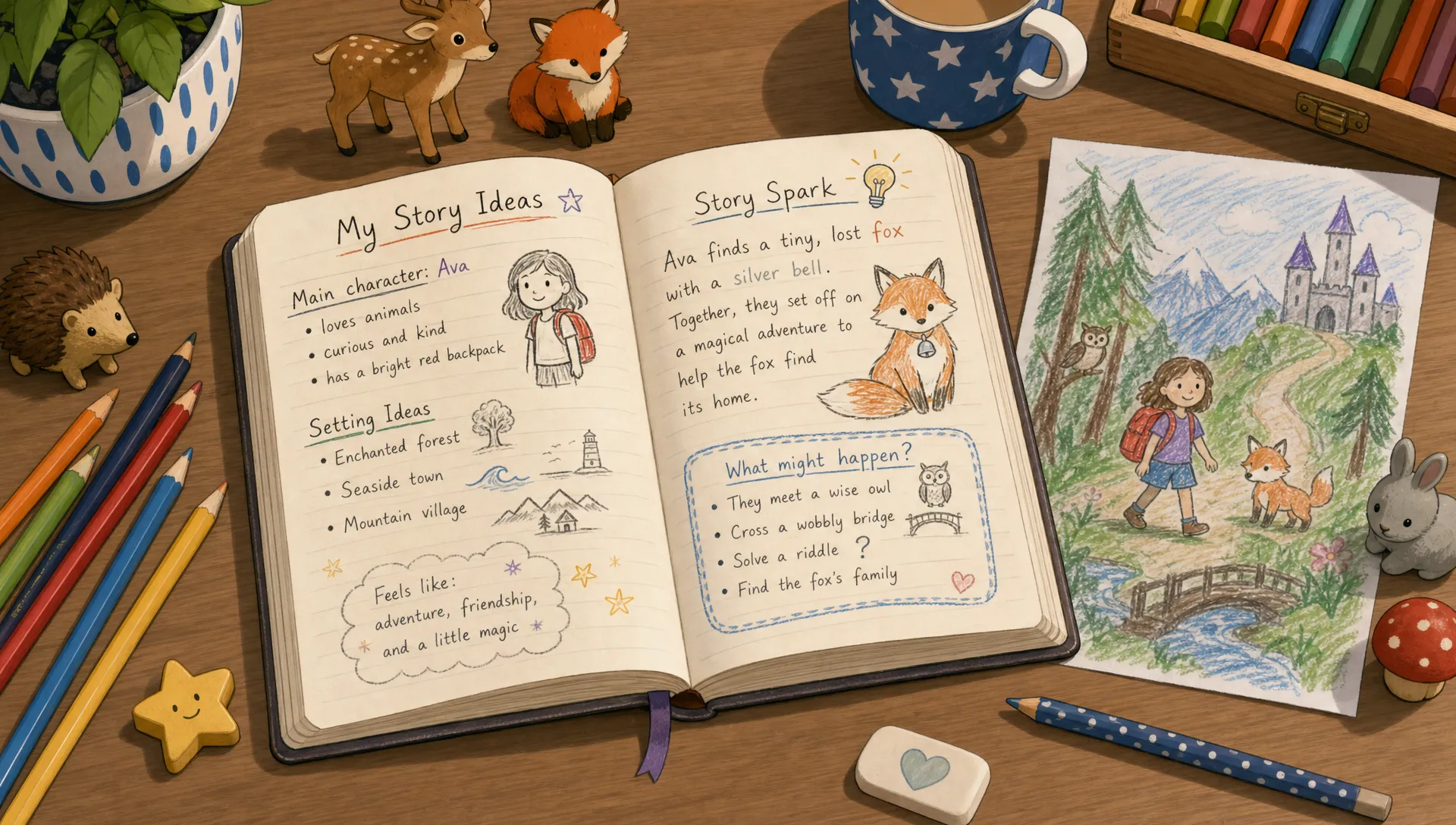
Try choosing three personal details:
- One character detail, such as a name, pet, sibling, or best friend
- One world detail, such as a garden, bedroom, beach, school, or favourite place
- One emotional detail, such as bravery, patience, curiosity, kindness, or confidence
That is usually enough to make the story feel personal without slowing it down.
Turn the idea into scenes, not summaries
A common mistake is to summarise the story instead of letting the reader experience it. “They went on an adventure and learned to be brave” may describe the plot, but it does not feel like a story yet.
Scenes make the idea come alive. A scene has a place, action, dialogue, and a small change.
Instead of writing, “Milo was scared of the dark,” you might write:
“Milo stood at the top of the stairs and looked down. The hallway was quiet, except for the tick-tock of the clock and the soft hum of the fridge. His torch flickered once. Then something under the coat rack sneezed.”
Now the reader can see, hear, and feel the moment. The fear becomes part of the scene.
When you draft, ask yourself:
- Where is this moment happening?
- What can the character see, hear, touch, or smell?
- What does the character say or do?
- What changes by the end of the scene?
You do not need every scene to be long. In children’s stories, short scenes often work beautifully, especially when each one has a clear image or action.
Keep the language easy to read aloud
If your story is for children, read-aloud rhythm matters. Many children experience stories through a parent, grandparent, teacher, or carer’s voice before they read independently.
The UK charity BookTrust has long championed shared reading because stories help families create routines, connection, and conversation. A good read-aloud story does not need complicated language. It needs clarity, rhythm, and moments that invite expression.
Try varying sentence length. Use shorter sentences for action or suspense. Use gentle repetition for comfort. Let funny words be funny. Let quiet moments breathe.
For example:
“Pip packed a sandwich, a spoon, and his lucky blue sock. He did not know why he needed the sock. But adventures were strange like that.”
The sentence pattern is simple, but it has personality. That is often what children remember.
Let pictures support the plot
Illustrations are not just decoration. In children’s books, they help readers understand characters, sequence, emotion, and setting. A picture can show that a character feels nervous before the words say it. It can reveal a hidden clue. It can make a magical world feel real.
When planning illustrated pages, look for visual moments. These are scenes that would be enjoyable to see as well as read.
Good visual moments often include:
- A character entering a new place
- A surprising discovery
- A funny mistake
- A strong emotion
- A before-and-after change
- A final cosy or celebratory image
If you want to think more deeply about visual storytelling, StoryStitch’s guide to how book illustrations help children follow a story explains how pictures support comprehension, pacing, and emotional connection.
Use AI as a creative partner, not a replacement for your idea
AI can make it much easier to create your own story from a simple idea, especially if you are not sure how to structure a plot or turn rough notes into polished chapters. The best results still begin with your personal spark.
Instead of asking AI to “write a children’s story” with no direction, give it a meaningful starting point. Include the main character, the reader’s age, the emotional tone, and the kind of ending you want.
For example:
“Write a cosy adventure story for a six-year-old named Amelie, who loves foxes and hates tidying her room. The story should be about a fox who helps her discover that tidying can be a treasure hunt. Make it gentle, funny, and suitable for bedtime.”
That prompt gives the story a reader, a character, a problem, a tone, and a purpose.
With StoryStitch’s AI storybook maker, you can start from a simple idea and shape it into a personalised storybook with structure, characters, illustrations, and finished formats. The process is designed to help you preview the idea before payment, edit the story, and create a book that can become an ebook, audiobook, or printed keepsake.
AI is especially useful for first drafts, chapter outlines, consistency checks, and illustration planning. Your role is still essential. You choose what feels true, what sounds like your child, and what kind of memory the story should become.
Try this practical example
Let’s take a tiny idea: “A child finds a star in the garden.”
That is a lovely image, but it is not yet a full story. Now we can develop it.
| Step | Example |
|---|---|
| Reader | A five-year-old who loves bedtime stories and space |
| Main character | Noah, a curious child who asks big questions |
| Want | Noah wants to help the fallen star get home |
| Problem | The star is too sleepy to shine, so the sky cannot see it |
| Attempts | Noah tries a torch, a song, and a jar of glow-worms |
| Turning point | Noah realises the star shines when someone tells it a kind memory |
| Ending | The star returns to the sky and twinkles above Noah’s window |
From here, the story almost writes itself. The beginning can show Noah spotting the star behind the flowerpots. The middle can follow each attempt. The ending can bring emotional warmth as Noah shares a memory and watches the star rise.
The final story might be about kindness, wonder, and the comfort of being watched over at night. All of that came from one simple idea.
Know when your story is finished
A story is finished when the main question has been answered and the emotional promise has been fulfilled. The character does not need to get everything they wanted, but they should gain something meaningful.
Ask these questions before you call the story done:
- Does the main character want something clear?
- Does something get in the way?
- Does the character make choices, rather than simply watch events happen?
- Does the ending connect to the beginning?
- Would the intended reader understand what changed?
- Is there at least one moment they might want to hear again?
For children’s stories, that last question is important. Re-readability often comes from a repeated phrase, a funny character, a comforting ending, or a moment of recognition. If the child asks for the same story again, the story has done something right.
Common mistakes to avoid
One common mistake is starting with too many ideas. A dragon, a pirate ship, a magic school, a lost puppy, a robot, and a birthday party might all be fun, but together they may overwhelm the story. Choose one main idea and let everything else support it.
Another mistake is solving the problem too quickly. If the character gets what they want immediately, there is no journey. Add small obstacles, misunderstandings, or attempts that do not quite work.
It is also easy to forget the reader. A story written for a young child should not be crowded with long explanations. A story for an older child can handle more detail, but it still needs pace and clarity.
Finally, do not polish forever before you finish a draft. A complete rough story is easier to improve than a perfect first paragraph with nowhere to go.
From idea to finished book
Once you have a story seed, a character, a structure, and a few personal details, you have the foundation for a real book. The next stage is production: drafting chapters, refining language, planning illustrations, checking consistency, and choosing the format.
If you want a guided process, StoryStitch has a step-by-step guide to making a storybook that walks through idea, preview, chapters, illustrations, and finished editions.
The important thing is to begin. Your first idea does not need to be perfect. It only needs to be specific enough to open a door.
A child with a lost button. A fox who cannot sleep. A grandad who keeps a dragon in the shed. A birthday balloon that floats to the moon. Any of these can become a story if you give the character a reason to move, a problem to solve, and an ending that feels worth reaching.
Frequently Asked Questions
Can I create my own story if I am not a writer? Yes. Start with a simple idea, then build it around a character, a want, a problem, and an ending. You can always improve the language later, and AI tools can help you structure and draft the story.
What is the easiest way to start a story? Begin with one sentence: “A character wants something, but something gets in the way.” This gives you a clear story seed and stops the idea from feeling too vague.
How do I make a story personal for a child? Use a few meaningful details, such as the child’s name, favourite animal, familiar place, pet, hobby, or emotional challenge. Keep the details connected to the plot so the story still flows naturally.
How long should a children’s story be? It depends on the child’s age and the format. A short bedtime story may be only a few pages, while an illustrated chapter story can be much longer. Clarity and pacing matter more than word count.
Can AI turn my idea into a finished storybook? AI can help turn a rough idea into a structured story, draft chapters, support consistency, and create illustration ideas. You should still review and edit the result so it reflects your voice and the child it is made for.
Create a story from the idea you already have
You probably already have the beginning of a story in mind. A character, a memory, a funny question, or a little moment from real life may be all you need.
With StoryStitch, you can turn that spark into a personalised storybook, preview it before payment, edit it in the story studio, and create a finished edition to read, listen to, or keep in print. Start with the simple idea. The story can grow from there.