Guide
Backed by 46 Studies: Reading Aloud Benefits Parents Can Use Tonight
Backed by 46 Studies: Reading Aloud Benefits Parents Can Use Tonight
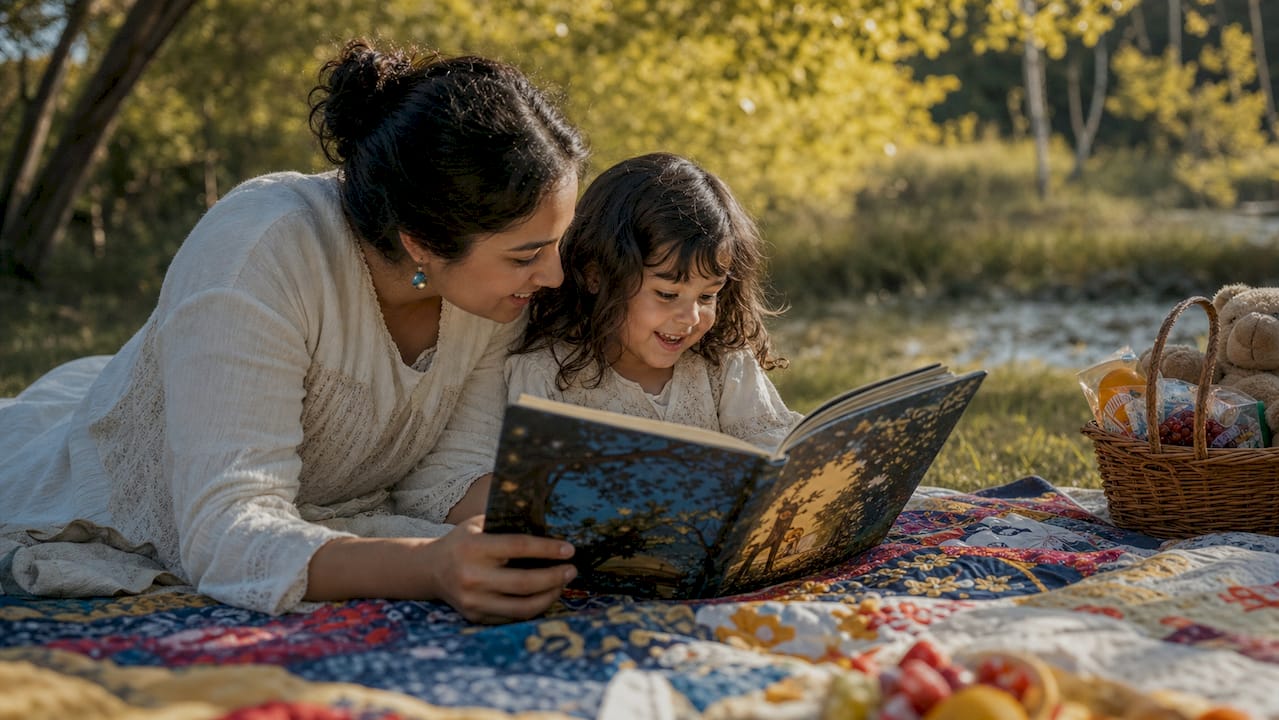
Reading aloud strengthens early language and vocabulary, sharpens memory for the reader through what researchers call the production effect, and deepens emotional bonds between reader and listener. The strongest support comes from a 2025 meta-analysis of 46 studies, cluster-randomized trials in classrooms, and a 2026 population-based study tracking outcomes for years. The sections ahead break down what the numbers actually mean and how to put them to use tonight.
TL;DR:
- Reading aloud improves vocabulary, listening comprehension, and language rhythm, with a meta-analysis showing a correlation of 0.381 between shared reading and language development.
- Randomized controlled trials indicate that read-aloud sessions lead to better reasoning and knowledge gains compared to passive listening, especially when sessions are interactive.
- Sustained shared reading from birth to age five is linked to higher resilience, prosocial behavior, and the formation of long-term reading habits.
- Reading aloud enhances memory for specific tasks through the production effect but does not reliably improve overall passage comprehension.
- Engaging, personalized books like those from StoryStitch can increase attention and reinforce dialogic reading techniques, forming a foundation for long-term reading habits.
Table of Contents
- What Are the Benefits of Reading Aloud, at a Glance?
- What the Strongest Studies Actually Show
- How to Make Read-Aloud Sessions Actually Work
- Why Adults Benefit From Reading Aloud Too
- What the Research Doesn’t Prove Yet
- How StoryStitch Fits Into a Read-Aloud Routine
- A Note From StoryStitch on Starting Small
- Turn Tonight’s Story Into a Keepsake
- Sources
What Are the Benefits of Reading Aloud, at a Glance?
Reading aloud pays off in three overlapping ways: literacy, cognition, and emotional connection. None of these operate in isolation. A child who hears more words also tends to form a closer bond with the reader, and that bond often predicts whether the habit sticks.

Literacy gains show up first and most visibly. Kids who are read to regularly build vocabulary faster, develop sharper listening comprehension, and absorb the rhythm of fluent language before they can decode a single word themselves. A 2025 meta-analysis spanning 46 studies and more than 56,000 children found a correlation of r = 0.381 between home-based shared book reading and language or vocabulary acquisition, a moderate-to-strong effect by most social science standards.
Cognitive gains lean heavily on something called the production effect. When you read text aloud instead of silently, you encode it more distinctly in memory. That is not the same as instant genius, but it explains why some students recall material better after reading it out loud, and why some intervention studies have linked sustained read-aloud instruction to gains on measures of reasoning and knowledge.
Social and emotional gains are the quieter benefit, but arguably the most durable.
- Vocabulary and oral language expand faster with regular shared reading than without it.
- Reading aloud yourself improves recall on memory-focused tasks, per production-effect research.
- Sustained shared reading in early childhood tracks with higher resilience scores at age six or seven.
- Even brief nightly sessions model fluent, expressive language that children mimic.
What the Strongest Studies Actually Show
Most of what gets repeated about reading aloud traces back to a handful of well-designed studies. Here is what they measured, and what the numbers mean in plain terms.
The largest is a systematic review and meta-analysis of dozens of studies covering tens of thousands of children. It found a meaningful correlation between home-based shared reading and general developmental outcomes, stronger for language and vocabulary. An r value that high means the relationship is real and consistent across dozens of independent samples, not a fluke in one small classroom study. It does not, by itself, prove causation, since most of the underlying studies were observational.
That is where the RCT evidence matters more. Three cluster-randomized controlled trials run in 2025 substituted part of standard language instruction with teacher-led read-aloud sessions over several months. The read-aloud groups showed stronger gains on measures of knowledge and thinking skills than controls. Because students were randomly assigned, this is about as close as this field gets to proving the practice itself drives the improvement, not just family background.
Longer-term, a 2026 population-based study followed children through their cumulative shared-reading history from birth to age five. Children with sustained shared reading showed higher resilience, more prosocial behavior, and stronger reading habits compared with children who were never read to. Those beta values describe the strength of the association after adjusting for other factors, and the reading-habit figure in particular suggests early exposure shapes whether a child becomes a reader at all, not just how well they read.
The limitation worth flagging: production-effect research shows reading aloud helps the reader’s memory on specific tasks, but it does not reliably improve passage-level comprehension compared with reading silently. Aloud reading is not a universal cognitive booster. It is a targeted one, strongest for memory and language exposure, weaker for raw comprehension.
How to Make Read-Aloud Sessions Actually Work
The technique matters as much as the habit. Passive reading, where an adult reads and a child just listens, produces real gains. Interactive reading produces bigger ones.
- Ask open-ended questions mid-story. Instead of “did the dragon win?” try “what do you think the dragon is feeling right now?” This is the core of dialogic reading, a technique with strong consensus support for outperforming passive listening on vocabulary and comprehension measures.
- Expand on what the child says. If they point and say “big dog,” respond with “yes, that’s a big, shaggy dog running through the mud.” You are modeling richer sentence structure without turning it into a lesson.
- Read the same book more than once. Repetition lets kids predict, fill in words, and eventually take over parts of the telling themselves.
- Keep sessions short and consistent. Ten to twenty minutes nightly beats an occasional hour-long marathon. Cumulative exposure over months and years is what shows up in the longitudinal data.
- Use your voice. Slow down for tension, speed up for excitement, and let pictures and gestures carry meaning for pre-readers who can’t yet follow text alone.
- Mix in audiobooks for variety, especially on nights when your voice is worn out, but treat them as a supplement rather than a replacement for interactive reading.
Choosing the right book matters too. Picking age-appropriate stories and understanding how illustrations support comprehension both make a measurable difference in how engaged a child stays through the story.
Pro Tip: If a toddler squirms after five minutes, shorten the session rather than abandoning it. A consistent two-minute habit builds more long-term value than an inconsistent twenty-minute one.
Why Adults Benefit From Reading Aloud Too
The production effect is not just for kids memorizing spelling words. Adults studying for exams often recall material better after reading their notes aloud rather than silently, because the act of speaking creates a second, distinct memory trace.
Beyond memory, reading aloud carries social and mood benefits for adults. Book groups, reading to an aging parent, or reading as a shared evening ritual has been linked in some studies to improved sleep and mood, alongside modest stress-reduction effects.
- Reading study material aloud strengthens recall on memory-heavy tasks, though not comprehension of complex passages.
- Joining or hosting a reading group adds a social layer that solitary reading lacks.
- Reading aloud to an older relative can double as cognitive engagement for both people involved.
- Persistent, uncharacteristic reading errors in an adult who previously read fluently are worth mentioning to a doctor, since they can occasionally signal an underlying neurological issue worth assessing.
What the Research Doesn’t Prove Yet
Earlier and more sustained shared reading tracks with stronger outcomes, but that dose-response pattern comes mostly from observational data, where family income, parental education, and general engagement all move together. Families who read more also tend to talk more, visit libraries more, and have more books in the house. The cluster-RCTs help isolate the practice itself, but they cover a narrow set of contexts and age ranges.
The clearest signal across the research is that quality beats quantity. Dialogic, interactive reading consistently outperforms passive reading on vocabulary and comprehension measures, even when total minutes are equal. The practical takeaway is not to obsess over hitting twenty minutes every night. It’s to make the minutes you do get genuinely interactive.
How StoryStitch Fits Into a Read-Aloud Routine
StoryStitch builds personalized, illustrated storybooks that put a child’s name, likeness, and interests directly into the narrative, available as ebooks, audiobooks, and printed keepsakes. Personalized characters tend to hold a child’s attention longer than generic ones, which matters given how much the dialogic techniques above depend on sustained engagement. Pairing custom stories with illustrations that support comprehension and characters that make a story feel personal gives families another practical tool for building the habit the research points to.

A Note From StoryStitch on Starting Small
We built StoryStitch because we kept seeing the same thing: kids lean in differently when the hero on the page looks and sounds like them. That is not a substitute for the research above, but it lines up with it. Start with one short story tonight, read it with some voices, and let the habit grow from there.
— StoryStitchApp
Turn Tonight’s Story Into a Keepsake
Generic picture books work, but a story where your child is the main character tends to hold attention longer, which is exactly the kind of engagement that makes dialogic reading techniques land. StoryStitch lets you build a personalized illustrated storybook from a simple idea, guiding you through characters, chapters, and matching illustrations without needing any writing or design experience.

Every book previews free before you pay, so you can see the first chapter and illustrations before committing. If you want a broader sense of the process first, families organizing home reading routines might also find value in early-years resources like Mooshie Moments’ home learning partnership. When you’re ready, try the AI storybook maker and unlock a story built around the exact voice your child leans in for.
Sources
- Home-based shared book reading and developmental outcomes in young children: a systematic review with meta-analyses
- Shared reading aloud fosters intelligence: Three cluster-randomized control trials
- Timing and duration of early-childhood shared reading and resilience, behavior problems, and reading habits
- Production effect and memory benefits of reading aloud