Guide
Bedtime Story Ideas Parents Can Use Tonight
Bedtime Story Ideas Parents Can Use Tonight
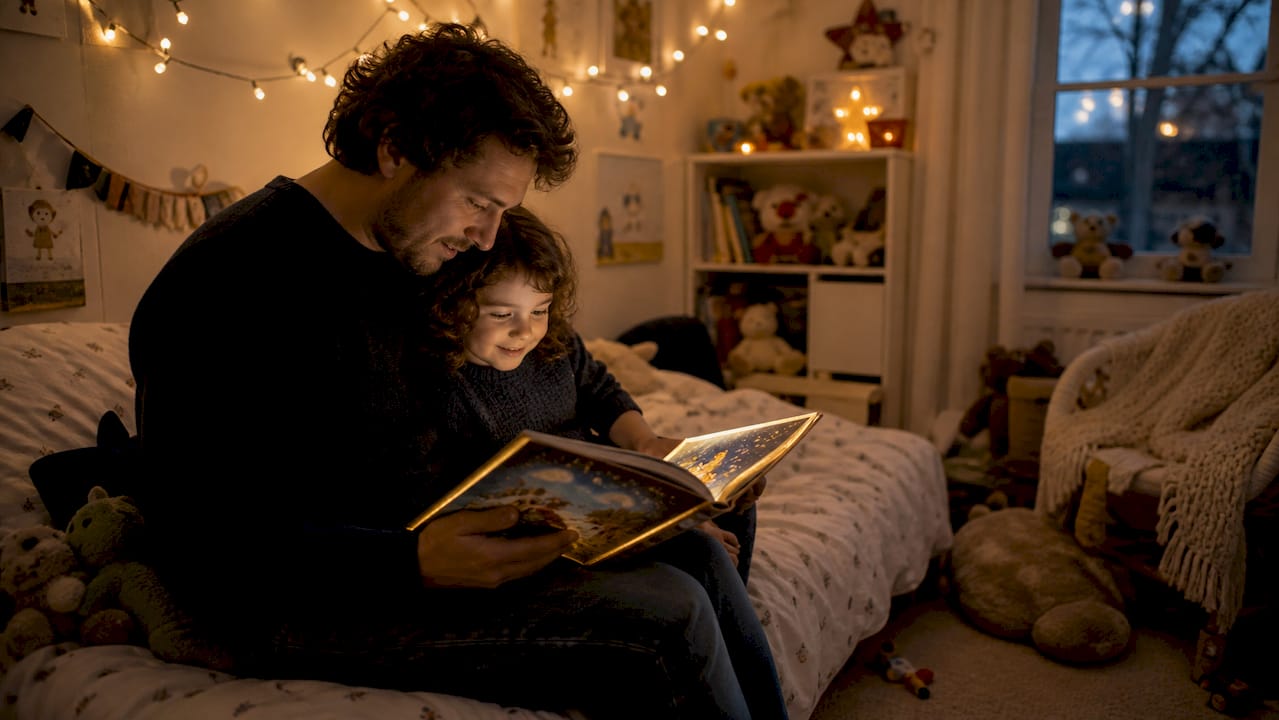
You need something to say the second your kid asks for a story, and this page gives it to you: ten instant prompts, four complete templates, four ready-to-read micro-stories, and calming scripts tuned to breathing and sleep. Everything scales from toddler to third grader, and none of it requires you to be clever at 8:12 p.m.
TL;DR:
- Using small, specific details in stories, such as a cloud getting lost or a cookie jar guarding a secret, makes storytelling quick and easy.
- Structured templates like quests or everyday chaos offer adaptable frameworks that require minimal prep and can extend or shorten based on your child’s energy level.
- Calm, sensory stories relying on repetition and soothing sounds help slow children down before sleep, especially when paired with breathing exercises.
- Personalizing stories with your child’s interests, names, or familiar settings increases engagement and makes bedtime routines more effective.
- Starting with questions or involving physical actions can help reluctant listeners become interested and actively participate in bedtime storytelling.
Table of Contents
- Bedtime Story Ideas You Can Use in the Next Five Minutes
- Four Story Templates That Work Every Single Night
- Calming, Sensory Bedtime Stories for Winding Down
- Four Complete 2-to-5-Minute Micro-Stories
- Running an Interactive Story Without It Running Away
- Adjusting Bedtime Stories by Age
- Delivery Tricks That Make Any Story Land Better
- Slipping a Lesson Into a Story Without a Lecture
- Making Room for Different Backgrounds and Traditions
- Keeping a Reluctant Listener Actually Listening
- Turning What Your Kid Loves Into Tonight’s Story
- Why We Keep Coming Back to Templates and Prompts
- Turn Tonight’s Story Into a Book They Keep Forever
- Sources
Bedtime Story Ideas You Can Use in the Next Five Minutes
Some nights you don’t need a template or a structure. You need a line to start with, right now, and the rest follows once you’re talking. These ten cover the four moods that come up most at bedtime: adventure, calm, silly, and slice-of-life.
- A backpack in the closet starts glowing right before lights-out.
- The family dog can talk, but only between 8:00 and 8:15 p.m.
- A tiny cloud gets lost and floats in through the bedroom window.
- Socks keep disappearing, and tonight we find out where they go.
- A grandparent’s old photo comes to life for one story only.
- The moon forgets how to shine and needs a kid’s help.
- A cookie jar in the kitchen has been guarding a secret for years.
- The bathtub drain leads to an underwater kingdom, just for bath night.
- A stuffed animal wakes up lonely and goes looking for a friend.
- The wind carries a message from somewhere far away, just for one ear.
Take prompt three: “A cloud gets lost.” In under a minute, you can have it drift past a confused owl, bump into a chimney, and finally settle onto a hilltop to sleep, just like your child. Prompt seven works the same way: the cookie jar’s secret can be as simple as “it’s been saving one cookie for a rainy day,” and you’re done in ninety seconds. The trick isn’t plot. It’s picking a small, specific detail and following it until the character gets sleepy too.
Four Story Templates That Work Every Single Night
Random prompts run out. Templates don’t, because you’re reusing a shape instead of inventing one from nothing. Structured formats like these are why sites such as Brightly’s bedtime prompt collection keep circulating among parents who freeze up at story time. Four patterns cover almost everything you’ll need.
- The Quest: a character wants something, faces one obstacle, and gets it. Fill in the blanks: “[Character] needs to find [object] before [deadline].” Example: a fox needs to find the last acorn before winter, crosses a frozen stream, and makes it home by dinner.
- Everyday Chaos: a normal routine goes slightly wrong. Fill in: “[Character] tries to do [everyday task], but [small problem] gets in the way.” Example: a mouse tries to bake bread, but the oven mitts are too big, so the whole kitchen helps.
- The Adaptation: borrow a fairy tale or favorite show and swap one detail. “What if [familiar story] happened, but [character] was actually [twist]?” Example: what if the three little pigs were actually the wolf’s cousins, and they’d been pranking him all along.
- Choose Your Own Adventure: you pause and ask your child what happens next, then narrate their answer.
Pro Tip: Every template stretches or shrinks on demand. Cut the obstacle in half for a faster ending, or add a second small obstacle if your child’s still wide awake and wants more.
You’ll find dozens more starting points in this collection of story prompts for children’s books if you want a deeper well to draw from on repeat nights.
Calming, Sensory Bedtime Stories for Winding Down
Fast plots wake kids up. Calm stories slow down on purpose, leaning on texture, sound, and smell instead of action, and repeating phrases the way a lullaby repeats its chorus. That repetition isn’t filler. It’s what lets a child’s attention loosen instead of grip.
Six starters that lean into sensory stillness:
- A boat drifting on a lake so calm it barely makes a ripple.
- A blanket fort that gets warmer and quieter with every page.
- Snow falling silently over a sleeping town.
- A firefly blinking slower and slower until it lands.
- Warm bread cooling on a windowsill while the kitchen goes dark.
- A turtle tucking into its shell one leg at a time.
Here’s a short script built around breathing, since pairing narration with breath is especially effective for kids who are wound up at bedtime, according to research on shared reading and emotional regulation: “The boat rocks gently… (breathe in)… and settles into the still water… (breathe out). The stars come out one by one… (breathe in)… and the lake goes quiet and still… (breathe out).”
Drop your voice, slow your pace by half, and repeat the same closing line if your child wants more. That predictability is the calming ingredient, not new plot.

Four Complete 2-to-5-Minute Micro-Stories
Sometimes you don’t want a template. You want a finished story, ready to read, done in under five minutes. Here are four, one per mood.
- Fantasy: “The Sleepy Dragon.” A small dragon named Ember can’t get to sleep because her fire keeps flickering when she’s excited. Her mother teaches her to breathe slow, cool breaths until her fire settles into a warm glow, just enough to light her cave like a night-light. Ember drifts off watching her own quiet flame.
- Everyday: “The Missing Left Shoe.” Every night, one shoe goes missing from beneath the bed. Tonight, a kid finally catches it: the family cat has been borrowing it as a pillow. They swap the shoe for an old sock, and the mystery ends in a truce.
- Funny: “The Burping Teapot.” A teapot at a very fancy tea party can’t stop burping bubbles instead of pouring tea. The guests laugh so hard the party turns into a bubble fight, and everyone goes home giggling and slightly damp.
- Calming: “The Whale’s Lullaby.” A whale hums a low, slow song to guide baby fish to sleep across the ocean floor, and the humming gets quieter with every verse until the whole reef is silent.
Trim any of these to ninety seconds by cutting the setup line, or stretch them by adding one more sentence of description before the ending. Reach for a micro-story on nights your child is too tired to make choices, and save interactive prompts for nights they’ve got energy left to spend.
Running an Interactive Story Without It Running Away
Choose-your-own stories are great until they never end. The fix is a simple three-step loop: offer a choice, narrate a short consequence, then offer a forced-closure choice that leads toward sleep no matter what they pick.
- “Left path or right path?” then two sentences of what happens, then “Do you want to sleep in the cave or head home now?”
- “Feed the dragon or pet the dragon?” then a short reaction, then “Do you want to say goodnight to the dragon or tuck it in?”
- “Climb the tree or dig a tunnel?” then a quick result, then “Ready to close your eyes here, or one more stop first?”
Guides built around this format, including Brightly’s closure guidance for bedtime prompts, stress that every interactive branch needs an exit built in, or you’ll be narrating at 9:30.
Pro Tip: Keep your final choice binary and both options sleepy. “Nap under the stars or nap in the treehouse” ends the story either way.
Adjusting Bedtime Stories by Age
A three-year-old and an eight-year-old don’t need the same story, even from the same prompt. Sentence length, repetition, and how much you let them steer should shift with age.
- Ages 0 to 2: short sentences, heavy repetition, simple sounds. “The Sleepy Dragon” becomes: “Ember got sleepy. Ember breathed slow. Ember closed her eyes.”
- Ages 3 to 5: add cause and effect, one simple choice, gentle humor. Ember’s fire flickers because she’s excited, and calms when she breathes.
- Ages 6 to 8: add stakes, longer dialogue, and let them predict the ending. Techniques like this track with research on dialogic reading, which finds that adjusting interactivity to a child’s developmental level improves both engagement and language growth.
Skip anything genuinely scary before age six or seven, and watch your child’s face, not just their words. Wide eyes and stillness mean back off the tension, even mid-sentence.
Delivery Tricks That Make Any Story Land Better
The story matters less than how you tell it. Small delivery changes turn an average prompt into something genuinely calming.
- Drop your voice half an octave for narration; save higher tones only for excited dialogue.
- Slow your pace as the story nears its end, on purpose.
- End every story the same way, even different stories, so the ending itself signals sleep.
- Hand your child a soft toy to “hold” for a character in the story.
- Dim the lights before you start, not after.
- Use white noise or soft music as a consistent backdrop, night after night.
- If they’re too wound up mid-story, pause and say: “Let’s take three slow breaths with [character] before we keep going.”
- If they ask for “one more,” say: “One more, and this one ends with everybody asleep.”
Pro Tip: Pair your story routine with a physical cue, dimming lights, closing the door partway, so your child’s body starts recognizing “story time” as “almost sleep time” before you say a word.
Slipping a Lesson Into a Story Without a Lecture
The fastest way to kill a bedtime story is to make the moral obvious. Kids can smell a lesson coming, and they tune out the second a story turns into a lecture. The trick is to let the character learn something through what happens, not through what you announce.
Instead of ending with “and the moral is, you should share,” let the fox in your quest story actually try to eat the last acorn alone, fail to reach it stuck in a branch, and only get it down once a squirrel helps. The sharing happens in the plot, not in a summary line. Kids absorb it without feeling taught at.
Small edits do a lot of work here. If your Everyday Chaos story features a character who’s frustrated, let them try three different fixes before one works. That’s patience, dramatized instead of preached. If a character is scared of the dark, let them find one thing in the dark that turns out friendly, that’s a lesson about fear, delivered as plot.
Keep the lesson singular. One story, one idea, whether it’s honesty, patience, kindness, or trying again. Stacking three morals into one four-minute story dilutes all of them and drags out a story that should be winding down, not building up.
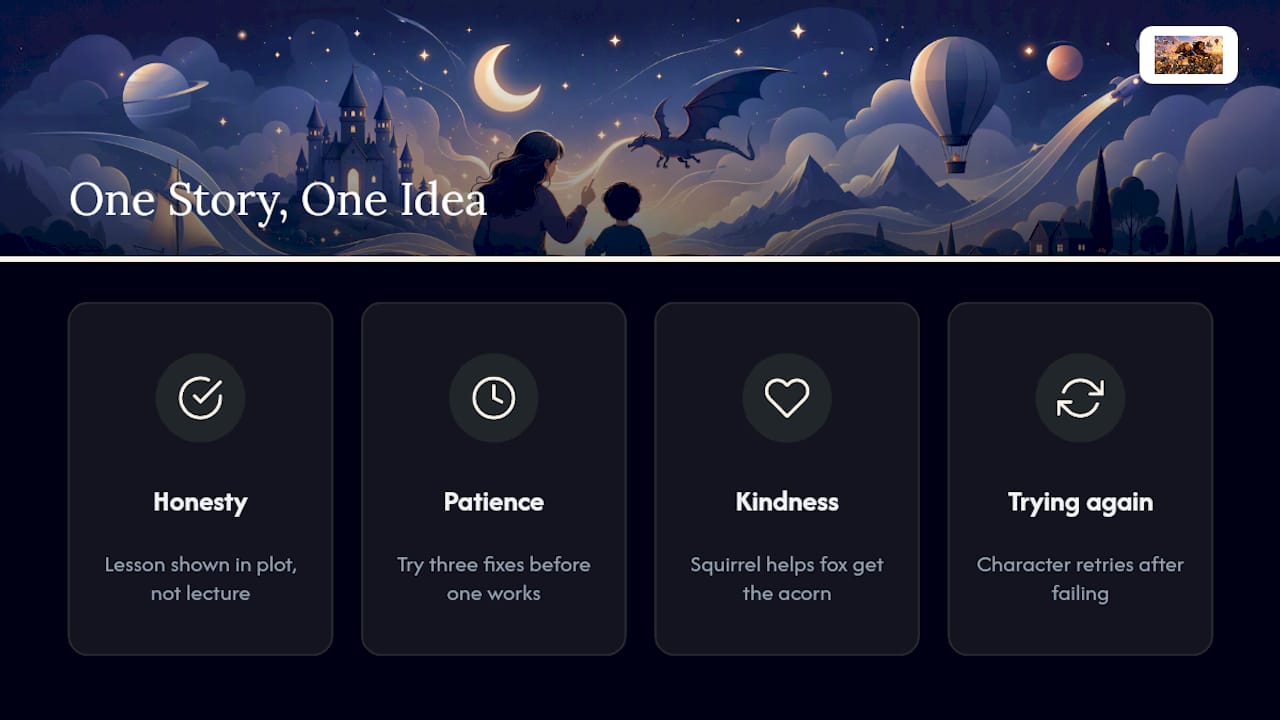
And skip the recap. If the story worked, your child already got it. Adding “so remember, sharing is important” after a good ending undoes the subtlety you just built.
Making Room for Different Backgrounds and Traditions
Bedtime stories are one of the easiest places to widen what a child sees as normal, simply by varying who your characters are and where your settings come from. A quest story doesn’t have to default to a generic castle. Set it in a night market, a fishing village, a mountain town, or a neighborhood that looks like your own street, and the story feels just as magical while quietly expanding what your child pictures as “a place stories happen.”

The same goes for characters. Names, family structures, and traditions can vary from story to story without any of it needing an explanation or a lesson attached. A grandmother who tells stories in a different language at the start of a tale, a family that celebrates a holiday your child hasn’t heard of, a character who uses a wheelchair and still goes on the adventure, none of these need to be the point of the story. They can just be part of the world, the same way a talking fox is part of the world.
This matters more than it sounds like it should. Kids build their sense of “who gets to be the hero” partly from repetition, story after story, night after night. If every hero looks and lives the same way, that becomes the default in a child’s head without anyone deciding it on purpose. Rotating your settings, names, and family shapes across your prompt list costs you nothing extra at bedtime. It’s the same fill-in-the-blank template, with different blanks filled in.
Keeping a Reluctant Listener Actually Listening
Not every kid wants a story every night, and forcing enthusiasm never works. Some nights the fix isn’t a better story, it’s a different way in.
Start with a question instead of a sentence. “What’s the bravest animal you can think of?” gets a reluctant listener talking before they’ve agreed to listen to anything, and whatever they answer becomes your main character. Handing them a job helps too, ask them to make the sound effects, or decide what the villain’s name is, and they’ve bought into the story without meaning to.
Cliffhangers work on skeptics better than they work on eager listeners. Stop mid-sentence, at the exact moment something’s about to happen, and most kids who claimed they didn’t want a story will ask what happens next. That’s your opening.
Physical involvement helps too. A story that includes a real action, patting a “sleeping dragon” stuffed animal, or whispering a made-up password to open a “door,” pulls a distracted kid back into the room. And sometimes the honest move is shortening the story itself. A reluctant thirty-second story tonight beats a forced five-minute one that ends in a fight about bedtime.
Turning What Your Kid Loves Into Tonight’s Story
The single best shortcut for engagement is obvious once you notice it: use what your child is already obsessed with. A kid deep into dinosaurs doesn’t need a fox in the quest template, they need a triceratops guarding the last fern on the mountain. Same structure, completely different level of buy-in.
Watch for the details, not just the topic. If your child loves trains specifically because of the sound they make, put that sound in the story, repeated, rhythmic, and calming. If they love a particular cartoon character’s catchphrase, let your hero say something close to it at a key moment. The specificity is what makes a generic template feel invented just for them.
This also solves the “tell me a story about me” request without you having to build a whole new plot from scratch. Drop your child’s name, their actual stuffed animal, or their real bedroom into any of the four templates above, and the Quest or Everyday Chaos story becomes personal in seconds. A dragon story becomes better the moment the dragon lives in a cave shaped like your child’s actual bedroom.
If a particular custom story becomes a repeat request, that’s worth paying attention to. It usually means you’ve found the exact mix of character, setting, and small joke your child wants night after night, which is precisely the kind of story worth writing down before you forget the details.
Why We Keep Coming Back to Templates and Prompts
We’ve watched enough exhausted parents freeze up at bedtime to know the problem is never a lack of imagination. It’s a lack of a starting point at 8:00 p.m. after a long day. That’s why StoryStitch leans so hard on structure, templates, fill-in-the-blank prompts, repeatable patterns, over chasing some mythical burst of creative inspiration every single night.
The stories that get requested again and again are rarely the most elaborate ones. They’re the ones with a character your child recognizes and a shape they can predict. If you want a deeper stock of starting points, our guide to picking read-aloud books by age and our tips on writing original stories kids ask for again both build on the same idea: structure beats spontaneity, every time.
— StoryStitchApp
Turn Tonight’s Story Into a Book They Keep Forever
That dragon story you improvised, or the one your kid keeps asking for by name, doesn’t have to disappear once the lights go off. StoryStitch turns a single bedtime idea into a fully illustrated personalized storybook, built through a guided process that keeps characters and art consistent from the first page to the last.

You share the idea, and StoryStitch builds out the chapters, characters, and illustrations around it, with a free preview and first chapter before you pay anything. There’s no subscription: it’s a one-time unlock per finished book, with optional upsells if you want an audiobook version or a printed keepsake copy on the shelf. If tonight’s dragon story earned a repeat request, our step-by-step guide to making a storybook walks you through turning it into exactly that kind of keepsake, starting with the free preview.
Sources
- Reading aloud to children: father involvement and benefits (PMC)
- Bedtime Story Prompts for Parents Who Can’t Think of Any Stories to Tell — Brightly