Guide
Bedtime Routine Stories That Actually Calm Kids Down
Bedtime Routine Stories That Actually Calm Kids Down
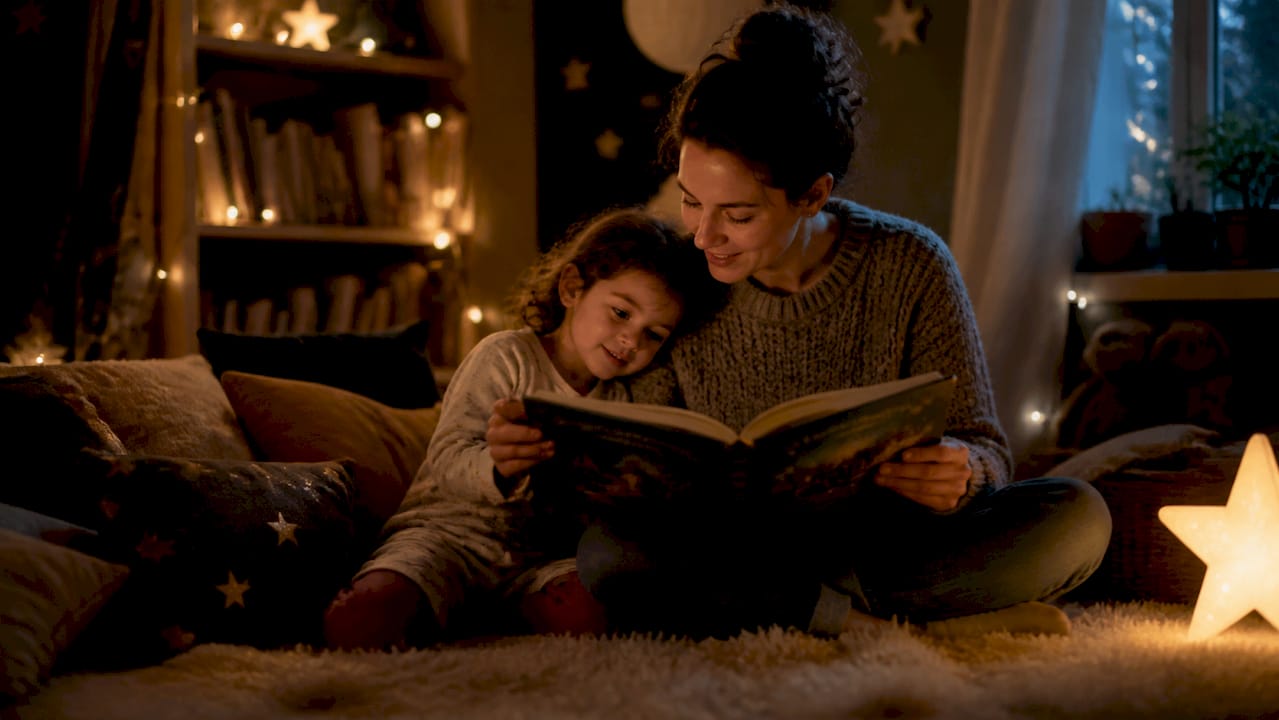
Tonight’s fix is simple: pick a short, low-conflict story, keep your voice slow and soft, and read it at the same point in the routine every night. Repetition and a predictable ending matter more than plot. A 5 to 10 minute rhythmic tale, a board book, or a made-up story that ends the same way each time gives a young child’s brain the cue that sleep is next. Age-specific templates and techniques follow below.
TL;DR:
- Short, predictable stories with a calming rhythm work best for infants and preschoolers, avoiding plot complexity, conflict, or scary imagery.
- Consistent routines, including same timing, sequence, and closing phrases, help children associate the process with sleep cues over time.
- Personalizing stories with the child’s name and familiar objects reduces guesswork, making bedtime a low-stimulation, predictable experience.
- Resistance often stems from routine or overtiredness, not the story itself, so fixed sequences and minimal participation options reduce stall tactics.
- Prioritizing ritual stability and predictable pacing over story novelty prevents bedtime struggles and creates a routine children look forward to.
Table of Contents
- Which bedtime stories work best by age?
- How do you build a calming bedtime story routine?
- What are some quick 5-minute bedtime story templates?
- Why personalized stories work better for bedtime routines
- What if my child resists bedtime stories every night?
- What we’d tell you if you only read one section
- Make bedtime stories a routine your child actually asks for
- Sources
Which bedtime stories work best by age?
The right story depends less on subject matter than on structure. A newborn doesn’t need a plot. A six-year-old needs one, but not much of one.
Ages 0 to 2 respond to sound before story. Nursery rhymes, sung phrases, and touch-and-feel board books work because infants are wired to respond to rhythm and repetition long before they track a narrative arc. Researchers at the University of Cambridge found that repetitive, rhythmic patterns are more effective at calming infants and supporting early language development than longer, complex stories. Keep it to a very short duration. The words matter less than the cadence. A line like “Rain, rain, softly falls, on the roof and on the walls” repeated with small variations does more work than an actual plot.
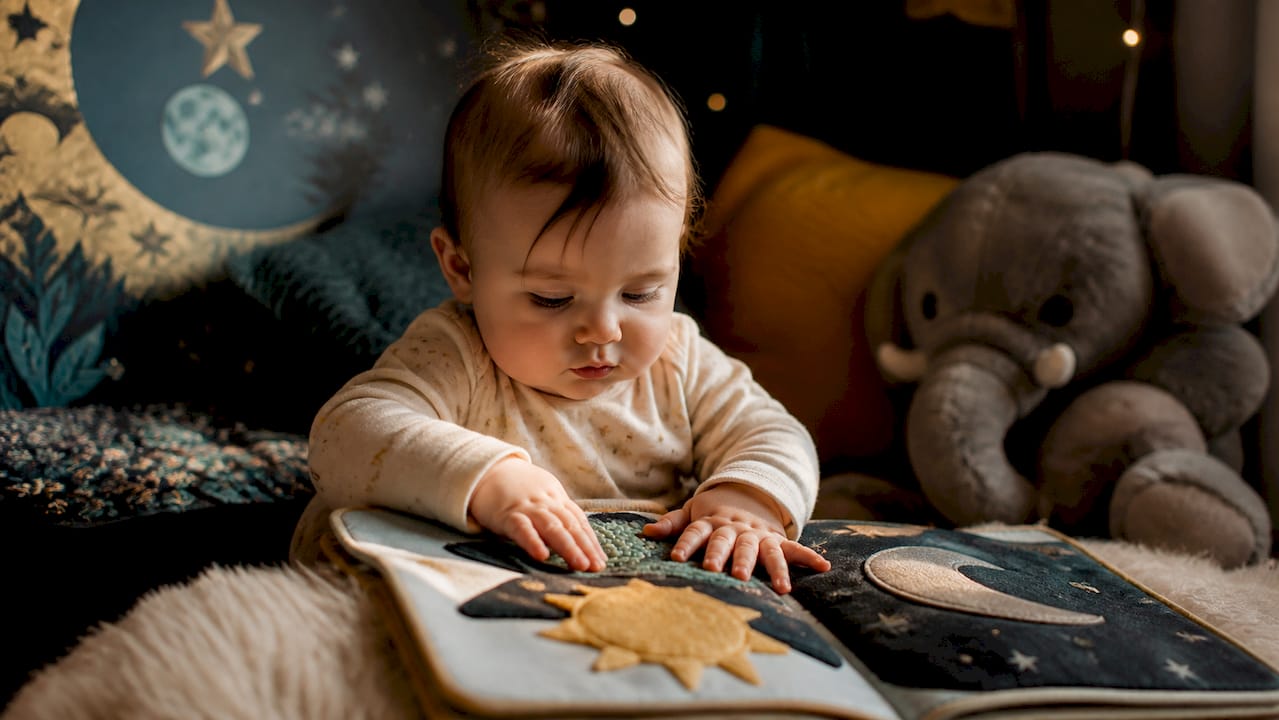
Ages 3 to 5 are ready for a story arc, but a small one. This age group does best with a single problem that resolves gently: a bunny who can’t find her blanket and then does, a bear who feels the dark is scary and then feels safe. The plot should never escalate past a mild bump. Predictable endings matter here more than surprise. If the story surprises a preschooler at 8 pm, you’ve just handed their brain a reason to stay alert. Keep it brief, with a rhyme or repeated refrain woven through.
Ages 6 and up can handle a short chapter or a gentle myth, something with a beginning, middle, and a clear resolution, but the pacing and stakes still need to stay low. This is the age where kids start asking for “real” stories, so parents often default to adventure or mild peril to hold interest. Resist that instinct at night. Save the dragon fights for daytime reading. At bedtime, a calm short-chapter story with soft language and a satisfying, unambiguous ending works better than a cliffhanger, because cliffhangers are designed to keep the brain working, which is the opposite of what you want at 8:30 pm.
Across every age band, a few things reliably backfire:
- Loud conflict or danger, even if resolved happily, spikes alertness right when you want it dropping.
- Scary imagery, villains, or “what if” scenarios that invite a child to imagine worst cases.
- Fast pacing, cliffhangers, or plot twists that reward staying awake to find out what happens.
- Heavy moral lessons delivered as a lecture. Kids’ brains tend to shift into analytical mode when a story feels like it’s testing them, which is the opposite of winding down.
- Anything screen-based right before the story. The light and stimulation cancel out most of the calming effect of even a great story.
Curated lists from publishers and parenting sites tend to agree on this pattern: short, mindful picture books with predictable sequencing outperform longer or more exciting titles for bedtime specifically, even when those longer titles are excellent daytime reads, according to Brightly’s roundup of routine-building bedtime books. If you want a running list of age-sorted read-aloud options instead of picking blind, StoryStitch’s guide to choosing books for every age breaks it down further.
How do you build a calming bedtime story routine?
The story itself only does part of the work. The other part is doing the same sequence of things, in the same order, most nights. Kids settle faster into rituals their bodies recognize, not just stories they enjoy.
Here’s a workable nightly sequence:
- Cut screens 30 to 60 minutes before bed. Blue light and fast content both work against the wind-down you’re trying to create.
- Optional warm bath. Not required, but a mild body-temperature drop after a warm bath is a known sleep cue.
- Quiet play or a tidy-up ritual. Ten minutes of low-key activity, like putting toys away, gives kids a clear signal that the day is closing.
- Dim the lights in the bedroom before you start reading, not after.
- Tell or read the story. Five to ten minutes, same time, same spot.
- Close with a fixed phrase. Something you say every single night, word for word.
- A brief breathing exercise. Sixty seconds of slow breathing in, hold, out, said out loud together.
That closing phrase matters more than it seems. Short, ritualized language and a repeated goodnight line condition a child’s brain to treat the phrase itself as a signal that it’s safe to fall asleep, the same way a lullaby’s final note does. Once you pick one, don’t swap it out for variety. The lack of novelty is the point.
On delivery: keep your tempo slow, your volume soft, and lean into repetition rather than avoiding it. Kids don’t get bored of a well-loved phrase the way adults assume they will. Pause between sentences longer than feels natural. Journalists who’ve interviewed professional storytellers for bedtime specifically found that voice modulation, pausing, and small audience participation moments make a told story land better than reading flatly from a page, according to The New York Times. A little “what do you think happens next?” can work, but only early in the story. Save the passive, purely listened-to stretch for the final two minutes, when you want their brain settling, not generating ideas.
Here’s roughly how a typical bedtime window breaks down: a few minutes of tidy-up, time for the bath or wash-up, quiet transition and lights-down, story time, and a brief closing phrase and breathing exercise.
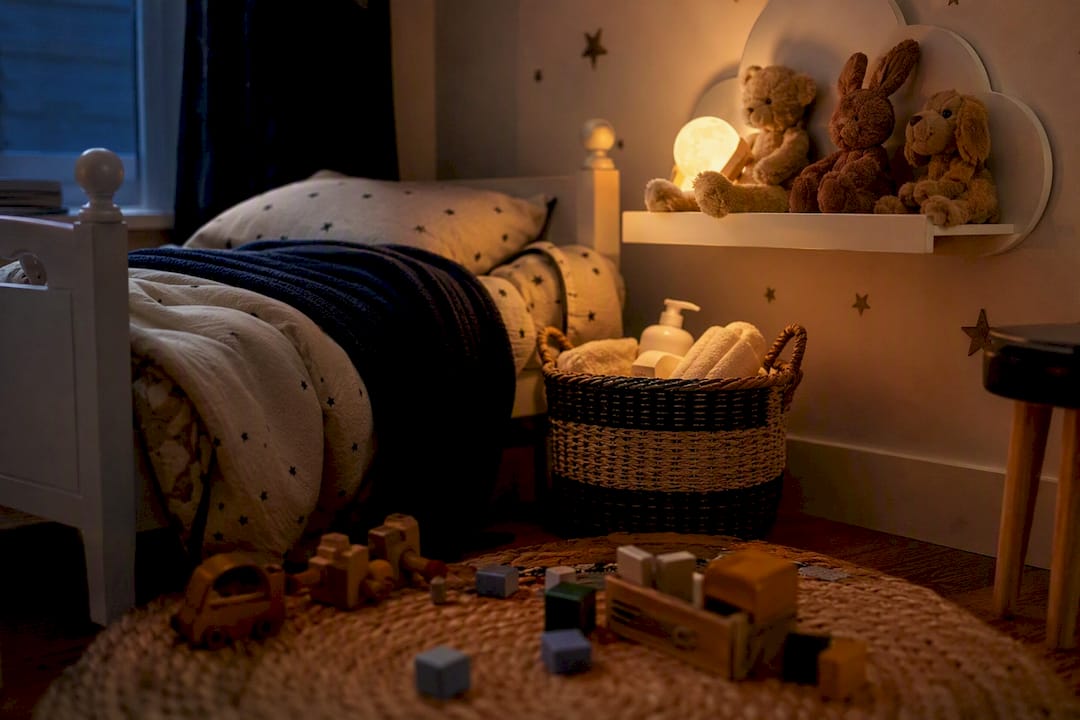
If your child fights the routine, resist adding excitement to win them over. It’s tempting to make the story punchier when a kid is resisting bedtime, but that tends to backfire by re-engaging the exact alertness you’re trying to lower. Instead, shorten the story, keep the tone even softer, and hold the line on the sequence. Consistency beats persuasion here.
Pro Tip: If your child asks “one more story” every night, pre-decide on two stories before you start, and say so out loud at the beginning. Kids negotiate less when the number was already agreed on rather than left open.
What are some quick 5-minute bedtime story templates?
Some nights you don’t have the energy to invent something new. These three templates give you a structure to fill in on the fly, no prep required.
- The rhythmic lullaby template. Pick a repeated line (“and the [animal] went to sleep”) and cycle through three or four characters, each doing the same calming action in the same words. Works best for ages 0 to 4.
- The quiet journey template. A character travels from one cozy place to another (forest to cabin, beach to blanket fort), meeting one gentle helper along the way, with no obstacle bigger than “tired feet.” Works for ages 3 to 7.
- The familiar-object comfort template. A favorite toy or blanket has a small, low-stakes adventure and returns home to rest, mirroring your child’s own night. Works well for kids attached to a specific object.
For nights you want a themed prompt instead of a blank page, keep a short list on hand sorted by mood: cozy (a warm kitchen, a soft-lit room), sleepy (a sloth’s whole day, clouds settling in for the night), safe adventure (a small boat on a calm lake), animal comfort (a fox curling up in its den), and home comforts (grandma’s porch, a favorite blanket). StoryStitch’s bank of 50 story prompts is built exactly for this, organized so you can grab one in seconds instead of freezing up at bedtime.
Personalizing any of these takes under a minute: swap in your child’s name, their actual stuffed animal, or a real place they know (grandma’s kitchen, the park down the street). Familiar details do more calming work than clever plotting. Close any of these with a 60 second breathing visualization: “Breathe in like you’re smelling a flower, breathe out like you’re blowing out a candle,” repeated three times.
Why personalized stories work better for bedtime routines
A story your child has heard before, with their own name in it, does something a brand-new story can’t: it removes the guesswork. There’s no new plot to track, no unfamiliar character to evaluate. That’s exactly the low-stimulation state you want at 8 pm.
StoryStitch builds on that by letting you generate a fully illustrated, personalized storybook where your child is the character, their pet or favorite toy makes an appearance, and a familiar fear (the dark, a new sibling, starting school) gets handled gently, with consistent art and narration from chapter to chapter. You submit an idea, guide the chapter and character setup, and StoryStitch handles the story, illustrations, and formatting, available as an ebook, audiobook, or printed keepsake.
Parents describe the same book being requested night after night once a child sees themselves in it. The predictability isn’t a limitation. It’s the entire mechanism that makes a bedtime story work.
If you’re building your first one, StoryStitch’s guide on creating a personalized book with AI walks through the setup in a few guided steps, and a separate guide on keeping it feeling magical rather than generic covers how to avoid an overstimulating result.
What if my child resists bedtime stories every night?
Resistance at storytime is rarely about the story. It’s usually a stall tactic, a signal of overtiredness, or a sign the routine feels negotiable. Storytelling itself can be the fix, but only if you use it as structure rather than a bribe.
Start by treating the story slot as fixed, not up for negotiation on timing or count. If a child says “no story” or “different story,” a calm, consistent response (“this is the one we read tonight”) works better than switching books to appease them, because switching signals that resistance gets rewarded.
Social-story style books that walk through the bedtime sequence itself, toys away, bath, brushing teeth, story, lights out, can help kids who resist because they don’t understand or accept the order of events. Seeing a character follow the same steps gives a resistant child a script to follow rather than a rule to fight. GrowTale’s step-based bedtime story is built specifically around this, explaining the sequence in narrative form rather than as a list of instructions.
For kids who stall by asking questions or requesting “just one more thing,” build a small, fixed amount of participation into the story itself, one question you ask them, one detail they get to choose, early in the telling. That gives them a sense of control before the passive, calming stretch begins, rather than letting the negotiation happen after you’ve said “the end.”
What we’d tell you if you only read one section
The advice that circulates most about bedtime stories overrates the story itself and underrates the repetition around it. Parents chase the “perfect” book when the actual lever is doing the same sequence, in the same tone, at the same time, night after night. A mediocre story told the same way every night beats a brilliant one told differently each time.
Where we’d push back on conventional wisdom: stop rotating books for novelty’s sake. Kids don’t get bored of a beloved story the way adults assume. What actually derails bedtime is usually pacing, screens too close to lights-out, or a plot with too much tension for 8 pm, not a lack of variety.
If you’re starting from scratch, prioritize the ritual structure first, then worry about story content. And if your child responds to seeing themselves in a story, personalized formats give you predictability and specificity in one package, which is difficult to manufacture from a generic library book alone.
— StoryStitchApp
Make bedtime stories a routine your child actually asks for
StoryStitch turns the fastest path to a calming bedtime ritual into something you build once and reuse for months: a personalized illustrated storybook with your child’s name, their favorite toy, and a familiar setting, told the same way every night without you having to invent a new plot on tired evenings.

Where a library book gives you someone else’s character and a generic ending, StoryStitch gives your child a story where they’re the main character and the pacing, tone, and resolution are set up for calm rather than excitement. You describe the idea, guide the chapters and characters through a short guided process, and get a finished storybook available as an ebook, audiobook, or printed keepsake, so the same soothing tale can live on a shelf, not just a screen. Start building your first personalized bedtime story with the AI storybook maker and see the first chapter before you pay for anything.
Sources
- Why reading nursery rhymes and singing to babies may help them to learn language — University of Cambridge
- How to Tell a Great Bedtime Story — The New York Times
- Sleepytime Stories: Books To Help Children Build a Bedtime Routine — Brightly
- My Bedtime Routine — GrowTale